Over 1.5 billion plastic toothpaste tubes end up in landfills every year. We help your oral care brand eliminate plastic waste without compromising on shelf life, formula stability, or margin — because a sustainable tube that fails on barrier protection is not sustainable at all.
Packaging is the single largest source of waste in oral care. These are the formats we run, with the barrier and stability data behind each one rather than a green claim on a spec sheet. See our sustainable packaging options.
Every option below has been run on our filling lines and through stability testing, so the switch is a specification change rather than a development project.
Mono-Material Recyclable HDPE Tubes
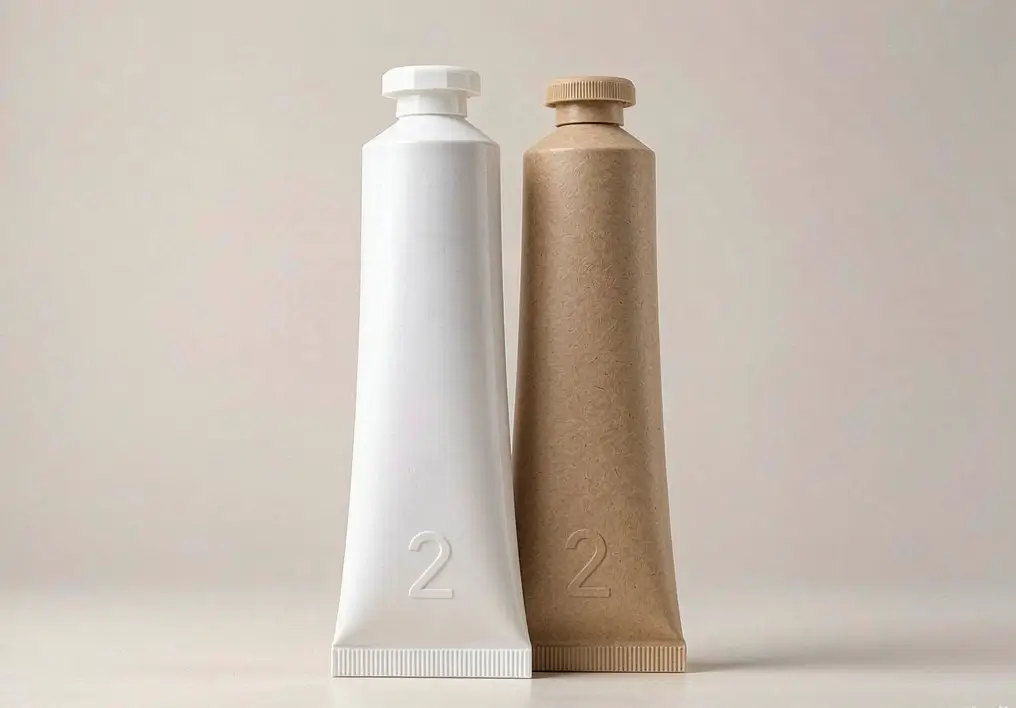
Moving from aluminium-barrier laminate (ABL) to 100% high-density polyethylene lets the tube enter the standard #2 curbside stream instead of being rejected as mixed-material waste. We validate flavour retention, active stability and moisture protection against the multi-layer equivalent before we call a mono-material tube qualified.
Post-Consumer Recycled (PCR) Plastics
PCR blends are available at 30%, 50% and 100% content across tubes, caps and pump dispensers. Because PCR resin can drift in colour and turn brittle, we specify food-grade PCR and run drop, crimp and appearance checks on the incoming material rather than only on the finished tube.
Aluminium & Glass Solutions
Zero-plastic options for brands positioned against plastic entirely: infinitely recyclable aluminium tubes and glass jars, suited to specialised pastes, powders and tablet formats. Aluminium tubes carry a well-established recycling stream in most markets, which makes the end-of-life story straightforward for your packaging copy.
Waterless & Solid Formats
Toothpaste tablets and powders remove the tube from the equation altogether. Because the water is taken out, shipping weight drops sharply — typically by around 70% against an equivalent paste volume — which cuts both freight cost and transport emissions per unit.
Inside the Tube
Clean, Ethical & Bio-Based Formulations
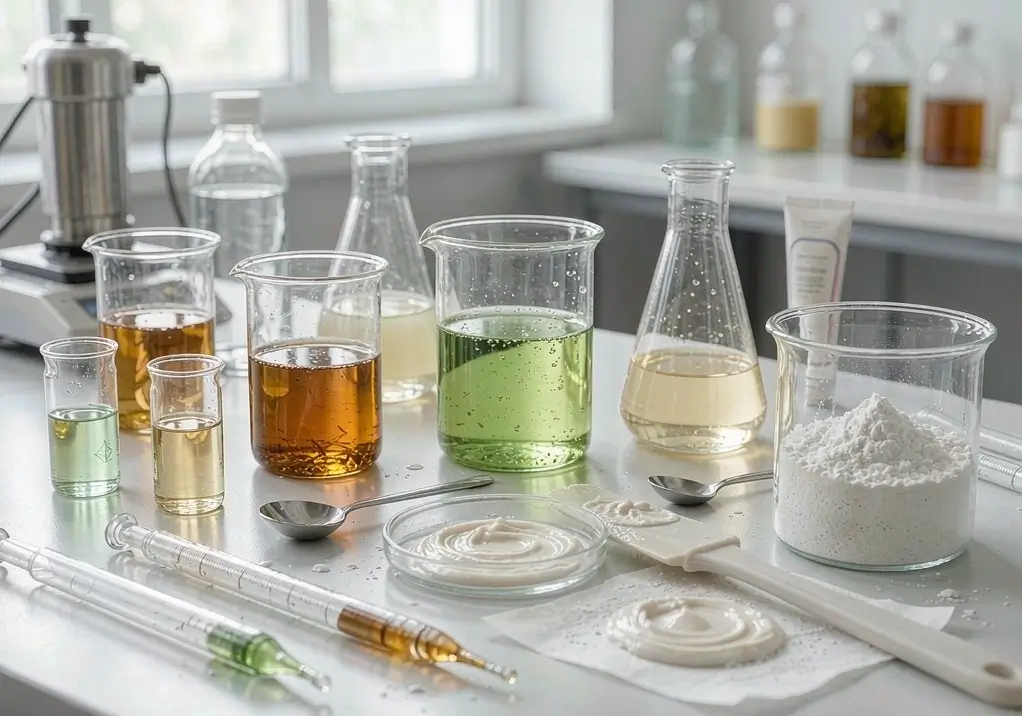
Sustainability has to survive contact with the formula. A recyclable tube filled with persistent microplastics is a partial answer, so we treat the ingredient list as part of the same brief. Including bio-based surfactants and microplastic-free abrasives.
Responsibly Sourced Ingredients
We specify 100% Roundtable on Sustainable Palm Oil (RSPO) certified glycerin to keep palm-derived inputs out of deforestation-linked supply chains, and use sustainably harvested or upcycled hydrated silicas and calcium carbonates for the abrasive system.
Microplastic & PEG-Free Guarantee
Complete elimination of polyethylene microbeads, microplastics and synthetic thickeners that persist in aquatic ecosystems. This is confirmed at ingredient approval, not discovered at audit — every raw material is screened against the restricted list before it reaches a formulation brief.
Biodegradability & Wastewater Safety
Formulations are designed to break down in municipal wastewater without harming aquatic life or bioaccumulating. Where a market requires it, we can develop fully marine and freshwater biodegradable, plant-derived systems and supply the supporting test data.
Facility Operations
What the Plant Itself Actually Does
Certifications describe a management system. This is the equipment and the numbers behind it, on our own site. Filed under our factory and capacity figures.
Energy & Carbon Footprint Reduction
On-site rooftop solar supplies a share of daytime plant load, and our vacuum mixing tanks run variable-frequency drives so compounding draws power against actual demand rather than at a fixed rate through the whole cycle.
Closed-Loop CIP Water Management
Tank and pipeline washdowns between runs are the largest water user in a paste plant. Our Clean-In-Place system filters and recirculates the rinse stream instead of sending it straight to drain, which cuts fresh water intake per changeover substantially.
Zero-Waste to Landfill Operations
Production scrap, packaging cut-offs and raw material drums are separated at source and routed to local recycling and upcycling partners. Laminate tube offcuts are the hardest stream to place, so we segregate them at the point of generation rather than mixing them into general waste.
85%waste diverted from landfill
60%+CIP rinse water recirculated
RSPOcertified glycerin sourcing
Partner ESG Support
Scope 3 Reporting & Retail Compliance
Enterprise buyers are scored on supplier emissions they do not directly control. We supply the data that makes your Scope 3 reporting and retail scorecards possible.
Life Cycle Assessment Transparency
Carbon footprint data for different packaging and formulation combinations, so you can model the emissions of a mono-material tube against an ABL tube before committing to tooling. Supplied in a format your ESG team can put straight into a Scope 3 calculation.
FSC-Certified Secondary Packaging
Unit cartons and shipping display boxes produced from 100% Forest Stewardship Council certified or recycled paperboard, with the chain-of-custody documentation your retail buyer will ask to see.
Retail Compliance Assistance
Support through retailer eco-assessments, including Whole Foods Eco-Scale and Sephora Clean & Planet Aware style criteria. We supply the ingredient, packaging and sourcing evidence those questionnaires request.
Yes. Modern mono-material HDPE tubes carry the #2 recycling code and are recognised by the Association of Plastic Recyclers (APR) for standard curbside collection, which is the whole point of moving off aluminium-barrier laminate. Traditional ABL tubes combine plastic and foil layers that most municipal streams cannot separate, so they are typically sorted out as residue. We confirm the resin and closure combination against APR guidance before we quote a mono-material format, because a non-conforming cap can disqualify an otherwise recyclable tube.
No, provided the construction is right. We use food-grade, FDA-compliant PCR resin combined with a specialised inner barrier liner, then run the finished filled tube through the same accelerated stability programme as a virgin-resin tube. The liner is what protects against flavour leeching and moisture ingress, so the PCR content sits in the structural layers rather than in contact with the paste. Shelf life is confirmed by test data on the actual combination, not assumed from the virgin equivalent.
Yes. Our formulation team can develop fully bio-based, plant-derived formulas that are marine and freshwater biodegradable, built on renewable surfactants and mineral abrasives with no persistent synthetics. The trade-off is worth stating plainly: a fully biodegradable system usually narrows the preservative and foam options, which can affect mouthfeel and shelf life. We run the stability and sensory work before you commit, so you know what the formula gives up before it goes on a carton.
It depends on the format, and the difference is mostly tooling. Stock mono-material HDPE tubes carry the lowest entry point because the tooling already exists, so they suit a first sustainable run or a market test. Custom-moulded PCR components need tooling and resin minimums, so they carry a higher MOQ. We quote both tiers side by side and tell you the volume at which the custom option becomes the better unit economics, rather than pushing you into tooling before the format is proven.
Next Step
Ready to Make Your Oral Care Line Eco-Friendly?
Request our B2B Sustainable Packaging & Formulation Playbook, or ask for a sample kit with the actual formats — mono-material HDPE, PCR blends, aluminium and waterless — in your hands so you can compare them directly.