MOQ: 10,000 PCS per SKU | Tiered Pricing from 20,000 PCS | In Stock & Flexible Wholesale
Foam & Flavour — Clean-Label, Clinically Backed
Surfactants & Sweeteners: The Science of Foam, Flavor, and Formulation
Modern consumers want the satisfying foam of a traditional toothpaste and a great taste, without the harsh sulfates or synthetic sweeteners. We formulate the perfect sensory experience using clean-label, clinically backed ingredients.
Buyers know what SLS is. What they need to know is what replaces it — and whether the replacement still foams like the product their customers are used to.
The SLS Shift & Mucosal Health
Sodium Lauryl Sulfate (SLS) is an effective traditional foamer, which is why it became the category default. It is also linked to disruption of the oral microbiome and to a higher frequency of aphthous ulcers (canker sores) in susceptible users — which is why an increasing share of briefs now arrive asking for it to be removed.
We formulate 100% SLS-free and SLES-free oral care products. Removing the sulfate is straightforward; the work is in rebuilding a foam profile that consumers do not read as inferior, and that still distributes the active evenly across the dentition.
Our Clean-Label Surfactant Portfolio
Sodium Cocoyl Glutamate
Amino acid-based
An amino acid-based, coconut-derived surfactant that produces a dense, creamy foam without stripping the oral mucosa. It is the closest sensory match to SLS we have found, which makes it the usual starting point for an SLS-free conversion.
Foam profileDense, non-stripping
Cocamidopropyl Betaine
CAPB / Amphoteric
A gentle amphoteric surfactant used either as the primary foamer or as a secondary alongside an anionic. Its mildness makes it the standard choice for sensitive-teeth formulations and for any brief where mucosal tolerance is the priority.
Typical rolePrimary or secondary
Sodium Methyl Cocoyl Taurate
Mild high-performer
A high-performing, mild alternative that stays stable in natural formulations containing botanical extracts. This matters because plant extracts are a common cause of surfactant destabilisation, and a foam that collapses in month four fails the product as surely as a bad flavour.
Best forBotanical formulations
Foam Volume vs. Density Testing
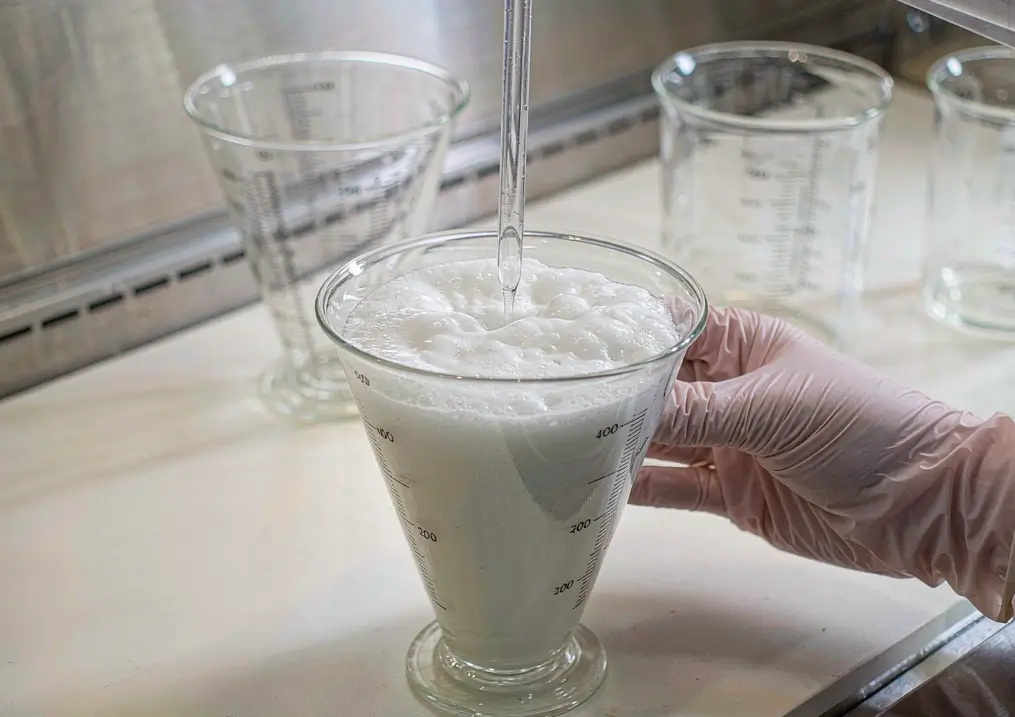
Foam is not decoration. It is the mechanism that carries active ingredients — fluoride, hydroxyapatite, desensitising salts — across the tooth surfaces and into the interproximal spaces a brush does not reach. A foam that looks generous but breaks down in the mouth distributes actives unevenly.
Our R&D lab uses Ross-Miles foam generation testing to measure both initial foam height and foam stability over time. We are looking at density and persistence, not just volume, because a tall, airy lather that collapses in ten seconds performs worse than a shorter, denser one that holds through a full brushing cycle.
Sweeteners
Sweeteners: Flavor, Function, and Cavity Defense
Flavour drives repeat purchase more than any claim on the carton. But the sweetener system also does real work — and in one case carries a safety obligation that cannot be ignored. Combined with our cavity-protection actives.
Xylitol: The Dual-Action Standard
Xylitol
Non-GMO, high purity
The premier B2B choice, and the one we recommend wherever the brief allows it. Unlike generic artificial sweeteners that only provide taste, Xylitol actively inhibits the growth and acid production of cavity-causing bacteria — the sweetener is doing therapeutic work, not just masking the base.
Typical inclusion5–10%
Claim supportWe source high-purity, non-GMO Xylitol at inclusion rates that support an active anti-cariogenic claim rather than a flavour-only one.
Pet-Safe Formulations
Veterinary
Xylitol is highly toxic to dogs — it triggers rapid insulin release and can cause fatal hypoglycaemia at doses that are trivial by human standards. This is not a labelling footnote; it determines whether a formula can be made at all.
Formulation warningFor any veterinary or pet oral care product we strictly substitute Xylitol with erythritol or sorbitol, and the product is made in dedicated mixing vessels to eliminate cross-contamination risk from human lines.
Stevia Extract (Rebaudioside A)
We use highly purified Stevia extracts to deliver a zero-glycemic, natural sweetening profile. The historical objection to Stevia in oral care is the bitter, liquorice-like aftertaste, which comes from the less purified glycosides — specifying Rebaudioside A at high purity removes most of it, and balancing it against the mint system removes the rest.
Erythritol & Sorbitol
Erythritol
Cooling effect
Used where the brief calls for a strong cooling sensation. Erythritol has a high negative heat of solution, so it produces a pronounced coolness on dissolution — useful for amplifying a mint profile without simply adding more menthol.
Sensory roleCooling amplification
Sorbitol
Sweetener + humectant
A dual-purpose material: it sweetens and it holds water. That second function is what prevents the paste from drying out in the tube and hardening at the neck — the failure mode consumers notice first when a humectant system is under-specified.
Dual functionSweetness + moisture retention
Synthetic Options (For Legacy Brands)
Sodium Saccharin remains available for clients replicating or reverse-engineering legacy mass-market formulas, where matching an established taste profile matters more than moving to a clean-label sweetener. We will tell you honestly when a legacy match is the right call and when it is worth reformulating.
From Our Lab
Inside the Sensory & Flavor Lab
How we make sure the flavour that ships is the flavour that was approved — and that it still tastes the same at the end of shelf life. Flavour profiles are built in our custom formulation service.
Flavor Mapping & Masking
Several high-value actives are actively unpleasant: potassium nitrate is salty and bitter, and a number of herbal extracts carry earthy or medicinal notes that no amount of mint fully hides. Masking is a balancing exercise rather than a cover-up — our flavour chemists work the essential oil ratio (peppermint, spearmint, anise) against the sweetener system, because the two interact. Raising sweetness to bury bitterness usually produces a cloying paste; adjusting the oil ratio often solves it without touching sweetness at all.
Essential oil to sweetener balancing
pH Stability & Surfactant Compatibility
Certain natural sweeteners and flavour oils destabilise foam over time, degrading the surfactant system gradually rather than all at once. To catch it, we run accelerated stability protocols — baking samples at 40°C / 104°F for 90 days — and measure foaming capacity and flavour intensity at each checkpoint. The question is not whether the paste survives, but whether the foam and taste at day 90 still match what was approved at day zero.
40°C / 104°F for 90 days, with foam & flavour checkpoints
FAQ
Foam & Flavor Formulation FAQs
Yes. By blending amphoteric and anionic natural surfactants such as Sodium Cocoyl Glutamate and CAPB, we can engineer a dense, satisfying foam profile that closely mimics SLS without the associated mucosal irritation. We verify the match with Ross-Miles testing rather than judging it by eye, so you get foam height and stability figures to compare against your current product before committing.
While both are excellent natural sweeteners, Xylitol actively inhibits cariogenic bacteria from fermenting sugars into enamel-destroying acids. That functional benefit matters most in pediatric oral care, where caries risk is highest and the sweetener is doing preventive work rather than just making the paste palatable. Stevia remains a good choice where a zero-glycemic profile or a specific natural positioning takes precedence.
We use EVOH barrier layers within our recyclable HDPE tubes to stop volatile flavour oils — peppermint in particular is prone to this — from migrating out through the packaging wall. Without that barrier, a mono-material tube can lose flavour intensity well before the end of shelf life. The barrier is specified alongside the recyclability requirement, so you do not have to choose between the two.
Yes. We formulate veterinary oral care products in dedicated mixing vessels using pet-safe sweeteners such as erythritol or sorbitol, strictly avoiding Xylitol because of its canine toxicity. Segregation is physical rather than procedural: using separate vessels removes the cross-contamination path entirely, which is the only approach we consider acceptable where the consequence of a mix-up is a poisoned animal.